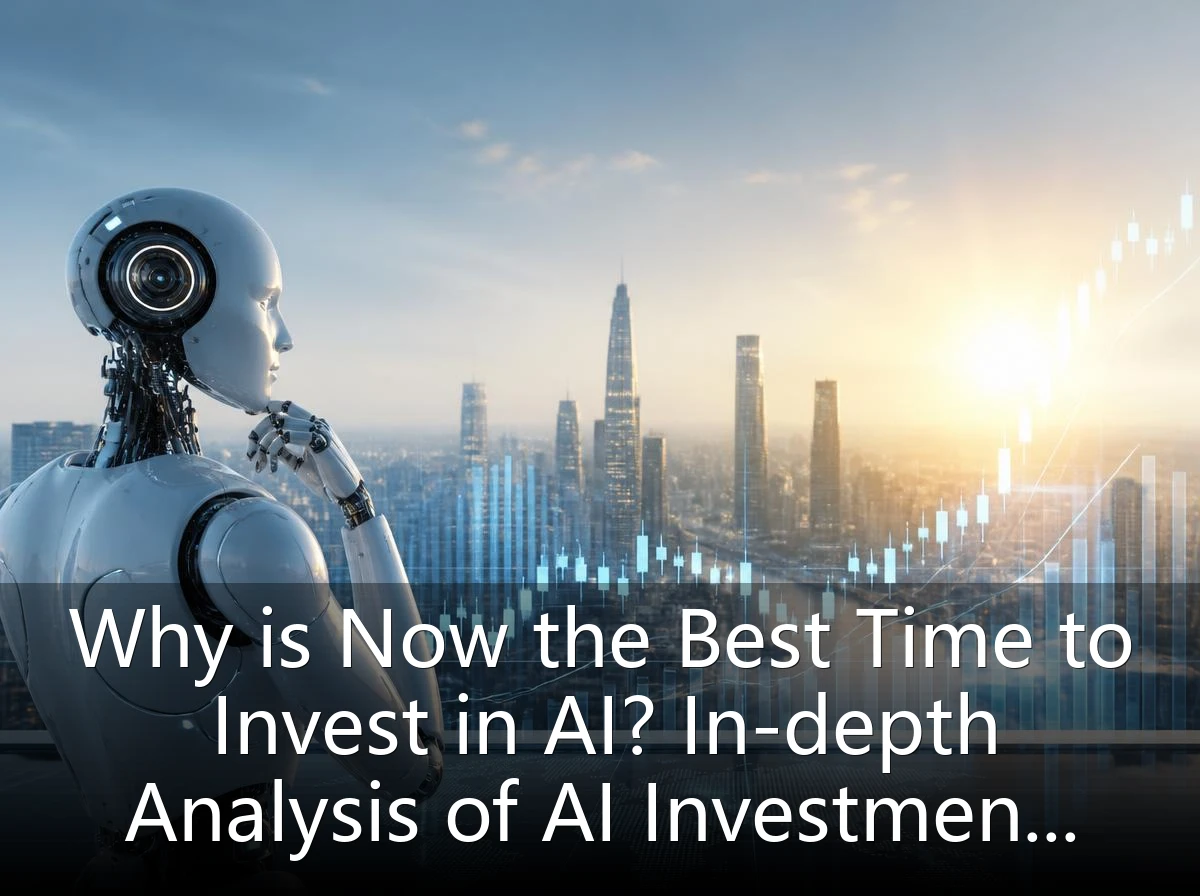
Introduction: AI Investment Enters a Golden Age
\nIn August 2026, the global artificial intelligence industry is experiencing unprecedented changes and opportunities. With the continuous iteration of large models like ChatGPT and Wenxin Yiyi, as well as the deep penetration of AI technology across various industries, artificial intelligence has transitioned from the conceptual hype stage to the substantive implementation stage. For investors, understanding the underlying logic of AI investment and grasping the key nodes of industrial development have become core capabilities for achieving excess returns in the digital economy era. This article will conduct an in-depth analysis of why now is the best time to invest in AI from four dimensions: macro value, industry trends, application scenarios, and investment strategies.
\n\nI. Macro Value Analysis of AI Investment
\nFrom a macroeconomic perspective, AI investment has become a new engine for global economic growth. According to the latest report from International Data Corporation (IDC), the global AI market size is expected to reach $1.8 trillion in 2026, with a compound annual growth rate as high as 38%. In China, the "AI Industry Ecology White Paper" released by the Ministry of Industry and Information Technology shows that by 2028, China's core AI industry size will aim for 800 billion yuan, driving a related industry size exceeding 10 trillion yuan.
\n\n1.1 Revolutionary Enhancement of AI on Productivity
\nArtificial intelligence is reshaping the global productivity landscape. Research by McKinsey Global Institute indicates that by 2030, AI technology is expected to contribute $13 trillion in GDP growth to the global economy, equivalent to a 16% increase in global GDP. This growth mainly stems from the deepening application of AI in key sectors such as manufacturing, finance, healthcare, and education, as well as the deep integration of AI with traditional industries.
\n\n1.2 New Economic Forms Created by AI
\nAI not only improves the efficiency of existing industries but also spawns entirely new economic forms. From AI content creation and AI intelligent agent development to AI drug discovery, AI is creating new business opportunities and job positions. Statistics show that in the first half of 2026, global AI company financing increased by 45% year-on-year, with Chinese AI company financing growing by over 60%, indicating the strong confidence of the capital market in the AI sector.
\n\nII. Latest Trends in AI Industry Development
\nIn the second half of 2026, the AI industry presents three clear trends that are reshaping investment logic and value evaluation systems.
\n\n2.1 From General AI to Vertical Domain AI
\nAfter several years of development, AI technology is evolving from general large models to specialized vertical domain applications. In professional fields such as healthcare, finance, and manufacturing, vertical AI models demonstrate higher practicality and commercial value than general models. For example, in the medical field, the accuracy of AI-assisted diagnostic systems has surpassed human doctors in certain specialties; in the financial field, AI risk control models can identify complex fraud patterns in real-time.
\n\n2.2 Migration of AI Technology from Cloud to Edge
\nWith the popularization of technologies like 5G and IoT, AI computing is migrating from the cloud to edge devices. This trend reduces the dependence of AI applications on networks, improves response speed, and also reduces privacy risks. The development of edge AI provides technical support for fields such as autonomous driving, smart homes, and industrial internet, creating new investment opportunities.
\n\n2.3 Deep Integration of AI and Real Economy
\nIn 2026, the integration of AI and the real economy has entered the deep water zone. From smart manufacturing to smart agriculture, from smart cities to smart healthcare, AI is changing the operational models and value creation methods of traditional industries. Especially in the manufacturing sector, AI-driven intelligent transformation has become a key means for enterprises to enhance their competitiveness, with related investment demand continuing to grow.
\n\nIII. Major Opportunity Areas for AI Investment
\nBased on the current development stage and investment hotspots of the AI industry, the following areas deserve attention:
\n\n- \n
- AI Computing Infrastructure: Including hardware facilities such as AI chips, servers, and data centers, which form the basic support for AI development. With the continuous expansion of large model parameter scales, computing demand is growing exponentially, and companies in the related industrial chain will continue to benefit. \n
- AI Large Model Technology: Including the research and application of general large models and vertical domain large models. Large models have become the commanding heights of AI technology competition, and companies with core technical advantages will gain long-term competitive advantages. \n
- AI Application Software: Including consumer-facing application software such as AI office software, AI design tools, and AI education platforms. With the popularization of AI technology, the application software market is expected to experience explosive growth. \n
- AI Enterprise Services: Including enterprise-oriented services such as AI customer service, AI data analysis, and AI supply chain management. The demand for enterprise digital transformation is strong, and the AI enterprise service market has huge potential. \n
- AI + Vertical Industries: Including vertical industry solutions such as AI + healthcare, AI + finance, and AI + education. AI application scenarios in vertical industries are rich and have clear commercial value, making them an important direction for AI investment. \n
IV. Risks and Challenges of AI Investment
\nDespite the broad prospects for AI investment, it also faces numerous risks and challenges that investors need to clearly recognize.
\n\n4.1 Technology Iteration Risks
\nAI technology is changing rapidly, and today's leading technologies may soon be replaced by new ones. Investors need to pay attention to technology development trends and avoid investing in technology paths that may be quickly eliminated.
\n\n4.2 Commercialization Implementation Challenges
\nAlthough many AI technologies show significant results in laboratories, they face numerous challenges in actual business environments, including data quality, user acceptance, and cost control. Investors need to evaluate the commercialization feasibility and business models of AI technologies.
\n\n4.3 Policy and Regulatory Risks
\nWith the widespread application of AI technology, governments around the world are strengthening AI regulation. Changes in regulatory policies on data privacy, algorithm transparency, and AI security may have a significant impact on AI companies. Investors need to closely monitor policy developments and assess compliance risks.
\n\nV. AI Investment Strategy Recommendations
\nBased on the analysis of AI industry development, we propose the following investment strategy recommendations:
\n\n5.1 Long-term Layout, Grasping Industry Trends
\nThe development of the AI industry is long-term, and investors should adopt a long-term investment strategy to grasp the long-term trends of AI industry development. Focus on companies with core technical advantages, clear business models, and strong team capabilities.
\n\n5.2 Diversified Investment, Reducing Single Risk
\nThe AI industry chain is long, including upstream hardware, midstream platforms, and downstream applications. Investors should adopt a diversified investment strategy to reduce risks in a single link or single enterprise.
\n\n5.3 Focus on Commercialization Process, Evaluate Profitability
\nThe commercial implementation of AI technology is key to realizing investment value. Investors should focus on the commercialization process, revenue growth, and profitability of enterprises, avoiding blind pursuit of concept hype.
\n\n5.4 Grasp Policy Orientation, Follow Industry Rhythm
\nThe development of the AI industry is greatly influenced by policy. Investors should closely follow national AI industry policy orientations, grasp the development rhythm of the industry, and find investment opportunities in key areas supported by policies.
\n\nVI. Conclusion: AI Investment, Embracing the Future
\nIn the second half of 2026, the AI industry is at a critical turning point from technological breakthroughs to commercial implementation. With the continuous maturation of AI technology and the continuous expansion of application scenarios, AI investment has entered a golden age. For investors, understanding the underlying logic of the AI industry, grasping development trends, and selecting investment targets with long-term value will yield generous returns in the digital economy era.
\n\nAs the famous investor Kevin Kelly said: "AI is not the trend of the future, but the reality of the present." In this era where AI is reshaping the industrial landscape, grasping AI investment means grasping the future. Investors should embrace AI change with an open mind and share the development dividends of the AI era driven by both technological innovation and commercial implementation.
\n\nThe future is here, and AI investment is timely.