Good, here is an article created based on the reference content and images you provided.
From Concept to Action: China's Leadership and Contribution in Global AI Governance
Introduction
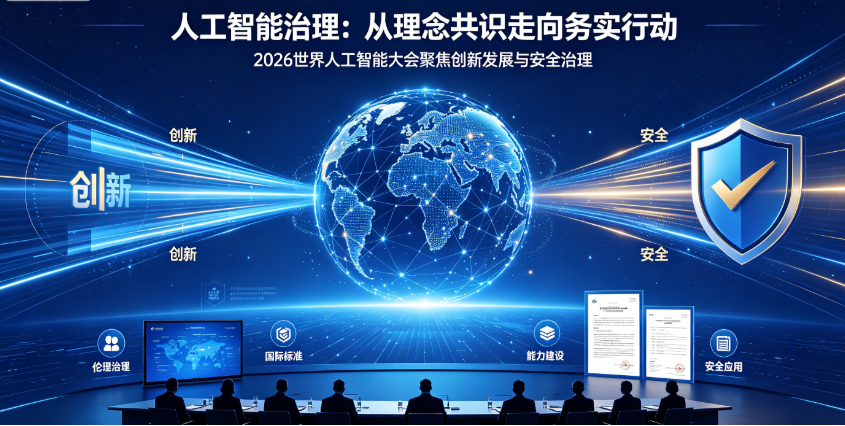
As artificial intelligence technology iterates at an exponential pace, while empowering various industries and reshaping socioeconomic forms, the ethical, safety, and governance challenges it raises are becoming increasingly prominent. How to balance the surging drive for technological innovation with the need to build a safe and trustworthy application environment has become a major common challenge for the world. At the recently concluded 2026 World AI Conference, this issue became the core focus. The conference not only witnessed the release of key outcomes such as the International Action Plan on AI Ethics and Governance, but also clearly outlined a governance path from abstract conceptual consensus to concrete, pragmatic actions. In this process, China's exploration and practice provide an indispensable reference and impetus for building a global AI governance system.
China's Approach: From ‘Crossing the River by Feeling the Stones’ to ‘Setting a Global Benchmark’
In the frontier field of AI governance, China is not a passive responder but an early pioneer in systematic exploration. Experts from various countries at the conference pointed out that China's valuable experience in promoting safe technology application and improving regulatory rules provides an important reference for the world. Mark Nitzberg, Executive Director of the Center for Human-Compatible AI at the University of California, Berkeley, strongly agreed. He stated directly that China has already made outstanding contributions to global AI governance, with many regulatory innovations first taking root in China before being adopted by other regions. Mr. Nitzberg explicitly said that they regularly engage in in-depth exchanges with the drafters of China’s relevant regulations and regard these regulations as ‘models.’
This evaluation is by no means mere praise. From early regulations on algorithmic recommendation and deep synthesis to recent systematic management of generative AI services, China has always adhered to the principle of balancing ‘development’ and ‘safety,’ striving to delineate clear legal red lines while encouraging innovation. This pragmatic and forward-looking governance approach not only effectively reduces potential risks from technology applications but also provides a ‘China sample’ for other countries to learn from. Especially against the backdrop of fragmented global governance and difficulty in reaching consensus, China's action capacity is particularly valuable.
 (Note: This image is a placeholder to reflect the position and logic of image citation in the article structure)
Standard-Setting Leadership: Integrating Chinese Wisdom into Global Governance Frameworks
China's contribution to global AI governance is not only reflected in specific regulatory practices but also deepened in international standard-setting and cooperation. Standardization is a foundational project for technical governance and a key link to building global consensus, lowering trade barriers, and promoting healthy technology development. Participating experts generally agree that China has become a core participant and important driver in international AI standard-setting.
Haarlesleben, Chair of CEN-CENELEC, the core European body for AI standardization, pointed out: ‘Standardization is inherently international. Although different regions have their own characteristics, China is clearly an indispensable and important participant.’ He particularly emphasized that Chinese experts hold leadership roles in multiple key working groups and directly assume editing responsibilities for several standard projects. This deep engagement means China can effectively transform its practical experience in application scenarios into universal technical norms, allowing ‘Chinese wisdom’ to play a substantive role in the global governance framework.
This shift from ‘participant’ to ‘leader’ not only highlights China's growing technological strength but also embodies its responsibility as a major country. By actively participating in working groups and leading standard projects, China has effectively promoted mutual understanding and collaboration on key issues such as AI ethics, safety, and data governance, contributing indispensable strength to bridging the ‘digital divide’ and building a ‘global governance perspective.’
Capacity Building: Bridging Governance Gaps through Extensive Consultation, Joint Contribution, and Shared Benefits
AI governance is not only a task for technologically advanced countries but also an urgent challenge for Global South countries. Many developing countries face significant shortcomings in technical capacity, legal frameworks, and talent reserves, exposing them to greater risks when enjoying technological dividends and exacerbating global governance imbalances. In response to this reality, China has demonstrated clear action commitments.
Over the next five years, China will provide 5,000 specialized AI training opportunities for developing countries. This initiative was highly praised by participants. Professor Shahbaz Khan, Director of the UNESCO Regional Office for East Asia, pointed out that while basic ethical principles (such as the UNESCO Recommendation on the Ethics of AI) have been established, the key lies in implementing these principles. He emphasized: ‘This requires strengthening capacity building to help countries truly understand these principles and effectively incorporate them into their national legal systems.’ Professor Khan believes that China’s announced ambitious training plan will play a crucial role in bridging governance capacity gaps.
This not only reflects China's fulfillment of its responsibilities as a major country but also embodies the principle of ‘extensive consultation, joint contribution, and shared benefits’ in global AI governance. Through knowledge transfer and talent training, China is helping more countries build their governance ‘infrastructure,’ enabling nations at different development levels to have equal development opportunities and dialogue capabilities amid the AI wave, thereby jointly building a more resilient and inclusive global governance system.
Conclusion
From pioneering domestic regulation, to deep participation in international standard-setting, to capacity-building support for developing countries, China has grown from an advocate of concepts to a backbone of action on the global AI governance stage. This year’s World AI Conference and its outcomes mark a new starting point: global governance is moving decisively from principled discussions fraught with disagreements toward a phase of collaborative action driven by pragmatic efforts.
In the critical field of AI, which concerns humanity’s future, there are no bystanders, and no outsiders. China’s practice proves that balancing innovation and safety, as well as development and governance, is not only possible but feasible. Only by working together under the guidance of consensus, sharing responsibilities, can we truly harness this powerful technology for the benefit of all humanity. In the future, the world expects China to play an even more pivotal and constructive role in promoting a new global governance framework that is people-centered and oriented toward goodness through intelligence.